Understanding Irish karst
What is karst?
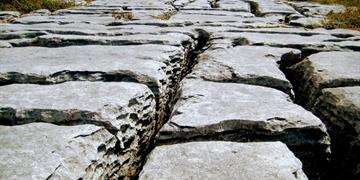
Karst is a landscape with distinctive hydrology and landforms that arise when the underlying rock is soluble. Although karst can develop on evaporate rocks such as gypsum and siliceous rocks such as quartzite, the vast majority of karst landforms are found on carbonate rocks, such as limestones.
Karst in Ireland
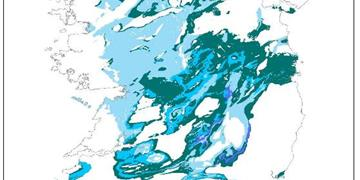
Karst principally occurs in the Carboniferous Limestone in Ireland. Limestones of Carboniferous age (300 – 340 million years ago) underlie approximately 43% of the Republic of Ireland, and 38% of the Island of Ireland, and consequently karst is very widespread. Karst is very important to Ireland for a number of different reasons.
Kast landforms
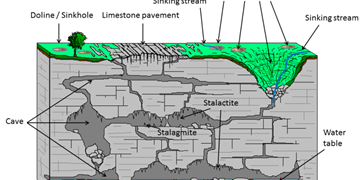
Karst comprises some of the most unique landscapes in the world, but it is also characterised by distinctive landforms. These characteristic landforms can be found both on the surface and below ground. Surface landforms commonly include enclosed depressions, sinkholes, sinking streams and springs.
Karst databases
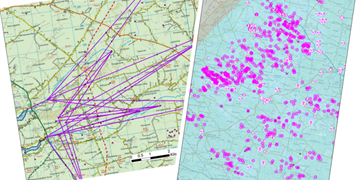
Geological Survey Ireland has two main databases that are specific to karst; The National Karst Landform database and the National Water Tracing database. Both databases are inventories of all known landforms and water trace experiments and contain details and attributes specific to each entry.
Karst geohazards
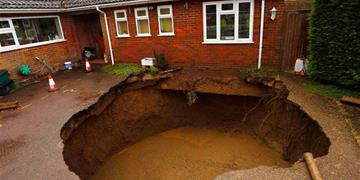
Karst landscapes are characterised by solution and voids in the bedrock and this can result in geohazards. An uneven bedrock surface, gradual ground subsidence or sudden collapse associated with subsurface voids can results in significant problems for engineering. Flooding is also a common geohazard associated with low-lying karst areas.