Planning Support and Guidelines
Useful publications for the preparation of planning documents relevant to the Geological Survey Ireland.
County Geological Sites

County Geological Sites should be included in County Development Plans and County Heritage Plans. Due regard should be given to sites of geological importance at all stages of planning, particularly in the development of quarries, wind farms and roads. If in doubt about County Geological Sites, please read the information on our Geoheritage page.
NRA Geology in Road Construction
National Roads Authority Guidelines on Procedures for Assessment and Treatment of Geology, Hydrology and Hydrogeology for National Road Schemes.
EPA EIAR Guidelines 2022
Environmental Protection Agency “Guidelines on Information to be Contained in Environmental Impact Assessment Reports” 2022.
IWEA Best Practice
Irish Wind Energy Association Best Practice Guidelines for the Irish Wind Energy Industry.
GSI / ICF Quarry Guidelines
Guidelines prepared by Geological Survey Ireland and the Irish Concrete Federation for the extractive industry in Ireland.
IGI Guidelines on EIAR
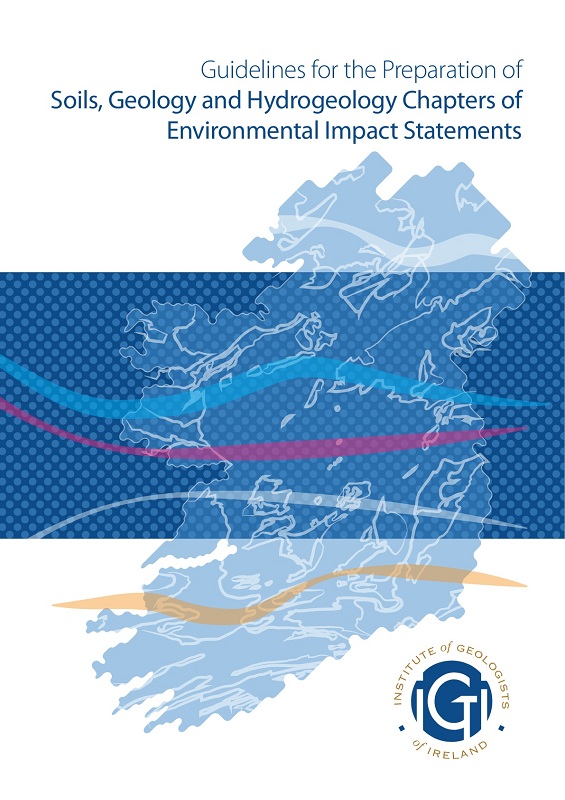
Guidelines for the preparation of the Soils, Geology and Hydrogeology chapters of Environmental Impact Assessment Reports (EIAR). Formally known as Environmental Impact Statements (EIS).
EPA SEA Screening Guidance
The Environmental Protection Agency’s “Good Practice Guidance for Strategic Environmental Assessment (SEA) Screening” provides specific stand-alone guidance to assist plan/programme makers and SEA practitioners.
Is there a County Geological Site near you?
Do you live on or close to a County Geological Site (CGS)?
Are you planning on carrying out work on or close to a CGS?
Are you the owner of a CGS location?
Are you interested in your local geoheritage?
Wind Energy Development Guidelines

The review of the Wind Energy Development Guidelines (2006) began with the issuing of initial draft proposals for public consultation in December 2013. The current draft Wind Energy Development Guidelines were published for public consultation in December 2019. The review of these guidelines is ongoing and is addressing a number of key aspects including noise, setback distance, shadow flicker, community obligation, community dividend and grid connections. Offshore wind farms are excluded from the provisions of the Planning & Development Act 2000.
Chapter 5 (Ground Conditions/Geology) of both the 2006 and the revised draft guidelines of 2019 indicates that the underlying geology is a critical factor in assessing proposed wind farm developments and that information on geology, landslides, geological Natural Heritage Area, or County Geoheritage Site, areas of significant mineral or aggregate potential, groundwater and any borrow-pits proposed must be submitted as part of a planning application.
The draft guidelines can be accessed here.
Guidance Documents for Offshore Renewable Energy Developers

Part 1 of the Guidance on Marine Baseline Ecological Assessments and Monitoring Activities Offshore Renewable Energy Projects document provides a non-technical summary of the baseline data requirements and monitoring that may be necessary to evaluate potential impacts of offshore renewable energy projects on the marine environment. It will be reviewed and updated as required. The guidance is intended primarily for developers, but will also be of benefit to consenting authorities during the consenting process.
Transport Infrastructure Ireland Planning Guidelines

Transport infrastructure Ireland is currently developing a series of environmental guidelines to facilitate further the integration of various environmental issues into national road scheme planning. Currently they have developed guidelines for the following environmental topics:
Noise & Vibration
- Ecological Impacts
- Flora & Fauna
- Architectural Heritage
- Archaeological Heritage
- EIA – Practical Guide
- Geology, Hydrology and Hydrogeology
- Landscape Treatments
Access TII Planning Guidelines here
Borehole and Well Head Construction Guidance
EPA Drinking Water Advice Note No. 14: Borehole Construction and Wellhead Protection Version: 1 Issued: 11 September 2013.
The objective of this Advice Note is to set out the recommended guidelines on how to construct a water supply borehole to internationally accepted standards and protocols for Irish conditions. The Advice Note sets out the guidelines on how a water supply borehole should be constructed given the nature of Irish aquifers, and the nature of common potential risks to groundwater quality in Ireland.
Code of Practice Domestic Waste Water Treatment Systems (Population Equivalent ≤ 10)
This Code of Practice (CoP) is published under Section 76 of the Environmental Protection Agency Act, 1992 (as amended).
Its purpose is to provide guidance on domestic waste water treatment systems (DWWTSs) for single houses or equivalent developments with a population equivalent (PE) of less than or equal to 10. It sets out a methodology for site assessment and selection, installation and maintenance of an appropriate DWWTS.
This CoP replaces the previous Code of Practice Wastewater Treatment and Disposal Systems Serving Single Houses (p.e. ≤ 10) issued in 2009. This CoP applies to site assessments and subsequent installations carried out on or after 7th June 2021. The 2009 CoP may continue to be used for site assessments and subsequent installations commenced before 7th June 2021 or where planning permission has been applied for before that date.
OPR Case Study Paper CSP07 – Quarries and the Local Authority Development Plan
This Case Study Paper was published by the Office of the Planning Regulator (OPR) in May 2025.
OPR Case Study Papers provide investigative research and analysis on specific areas of the planning system for practitioners, elected members and the public. The intention of the Case Study Paper (CSP) is to support planning authorities in the performance of their duties. For the avoidance of doubt, Case Study Papers do not have the status of Ministerial Guidelines under Section 28 of the Planning and Development Act 2000, as amended. They are issued to promote shared learning and highlight best practice, in accordance with the OPR’s statutory remit to engage in education, training and research activities. Case Study Papers cannot be relied upon as containing, or as a substitute for, legal advice. Legal or other professional advice on specific issues may be required in any particular case. Any comments/feedback in relation to this Case Study Paper may be sent to research@opr.ie